A guide for owners, buyers, and financiers. By MacReal International.
Own a yacht in Malaysia, or thinking of buying one? At some point, someone will need to put a number on it. That number matters whether you’re arranging insurance, applying for a bank loan, planning your estate, or negotiating a sale.
Getting it right takes more than looking up a price guide. Where the yacht is based, how it’s registered, what maintenance has been done, and which yard built it can all shift the value by ten to twenty percent or more. Here’s how MacReal International approaches yacht valuation, and what owners can expect.
Types of yachts we value
The Malaysian pleasure craft market covers five main vessel types. Each one is valued a little differently.
Motor yachts are the most common here. They range from compact 12-metre weekenders up to 30-metre flybridge cruisers. What we look at: engine hours, hull condition, teak decking, interior fittings, and how well the vessel has been maintained. Motor yachts lose value faster than sailing yachts in the early years, then tend to hold steady.
Sailing yachts are mostly concentrated in Langkawi and Penang. The Beneteau Oceanis, Jeanneau Sun Odyssey, and Hanse 458 are popular models. Rigging condition, the wires and fittings that hold up the mast, is what we watch most closely. It’s typically replaced every ten to twelve years, and commercial charter history matters a lot here too.
Sportfish boats are a smaller but steady segment, mostly in Sabah. Bertram, Viking, and Cabo are the names you’ll see. Engine condition is what drives most of the value.
Catamarans, twin-hulled sailing vessels, have been growing in popularity since 2020. Lagoon, Leopard, and Fountaine Pajot are common, mostly doing charter work in the Andaman Sea. They hold value well as a rule. What we check: bridgedeck underside condition and drive system service history.
Superyachts, anything above 24 metres, are rarely Malaysian-owned but pass through Langkawi and Kota Kinabalu for maintenance and resupply. Valuing them is a specialist exercise requiring international sales data and a working grasp of commercial charter licensing.
Does the brand matter?
More than people expect. Two yachts of the same size and age can be priced very differently, and the builder’s name is a significant part of why.
Top European yards, Princess Yachts and Sunseeker from the UK, Azimut, Ferretti, and Sanlorenzo from Italy, typically sit 15 to 25 percent above comparable vessels from lesser-known builders. Some of that is genuine quality. Some is perception. In Malaysia’s tropical climate, where UV, humidity, and saltwater push materials hard, both count.
Volume builders like Beneteau, Jeanneau, Bavaria, Galeon, and Prestige sit around the middle of the market. Well understood, widely serviced, easy to sell.
Lagoon and Fountaine Pajot hold value unusually well. Charter operators across Southeast Asia compete actively to buy second-hand units, which keeps prices firm.
Yards that are lesser-known or Asia-based typically trade at a 10 to 20 percent discount, even when the spec sheet looks similar. Buyers factor in parts availability and service depth, and that risk shows up in the price.
One thing we always do: check the builder’s identification plate on the hull, not just the badge on the transom. Some brands license their name to different yards, and quality can vary considerably.
How age and maintenance history affect value
Tropical Southeast Asia is hard on yachts. Strong UV, high humidity, constant saltwater exposure. The wear on hulls, paintwork, upholstery, and mechanical systems runs ahead of what you’d see in European or American waters. We apply a steeper depreciation curve for vessels that have spent their working lives in Malaysian, Indonesian, or Thai conditions.
What changes the picture is documentation. A 15-year-old yacht with a solid refit record, new engines, updated electronics, fresh hull coating, reupholstered interior, can be worth close to 80 percent of a vessel half its age. Without the paperwork to back it up, that same boat might fetch only 40 to 50 percent.
This is why we ask for maintenance records, invoices, and photographs. It’s not a formality. What you can prove directly affects the number.
Where the yacht is based and registered
Location matters more in Malaysia than in most markets. How the country taxes and regulates pleasure craft creates real value differences between ports.
Langkawi
Langkawi is the duty-free option. Under the Langkawi Development Authority (LADA) framework, yachts registered and based there avoid the import duty and sales tax that apply on the peninsula. On a vessel worth RM 8 million, that saving runs into the hundreds of thousands of ringgit. Part of it gets captured in market value when the yacht changes hands. Berth availability at the Royal Langkawi Yacht Club is tight, so berth transfer fees and waiting list status also factor into our assessments.
Sutera Harbour Marina, Kota Kinabalu
The main East Malaysia base. Deep-water berths, solid weather protection, access to some of the best cruising in Southeast Asia. Tight supply and charter-market demand mean values here tend to hold slightly better than equivalent vessels on the peninsula.
Royal Selangor Yacht Club, Port Klang
Serves the Klang Valley, with a large buyer pool among wealthier residents. Yachts here change hands more frequently than in other ports.
Separately, most Malaysian pleasure craft are registered through the Marine Department on standard national registration. Larger vessels sometimes use the Labuan International Ship Registry, which offers tax advantages for non-Malaysian owners.
Survey requirements
For yachts above RM 1 million, we don’t issue a valuation for financing or insurance purposes without a current condition survey. It’s a prerequisite.
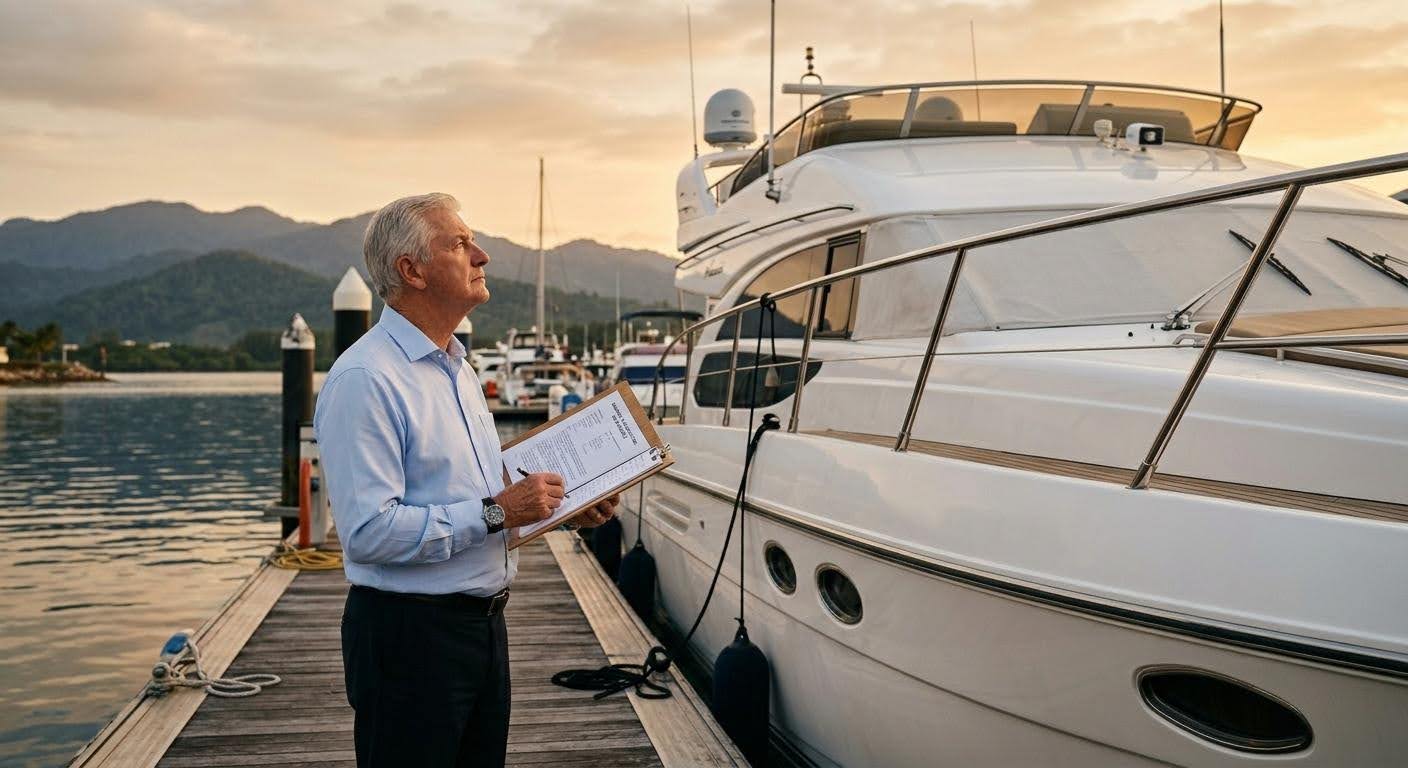
A condition survey is a full physical inspection by a qualified marine surveyor: hull and structure, engines, mechanical systems, electrical wiring, safety equipment, sea trial where practical. Malaysian banks and insurers typically require surveyors accredited by the International Institute of Marine Surveying (IIMS) or an equivalent body.
For yachts over ten years old, most insurers want a survey dated within the past 24 months before they’ll agree to insure at an agreed value.
No current survey? We can produce a desktop valuation: an assessment built from available documentation, without a physical inspection. We’ll note the limitations clearly, and we’ll recommend a full survey before the report is used for anything significant.
How we arrive at a value
Market comparison is our primary method: what have similar vessels actually sold for, or what are they listed at now, adjusted for the specific yacht in front of us.
Three sources feed that comparison.
Local broker listings from Simpson Marine, Asia Yachting, Lee Marine, and Northrop and Johnson Asia give us the live Southeast Asian picture.
International listing platforms give us the global benchmark for the same model and year.
Where we have actual transaction data through broker relationships, we see the gap between asking price and final sale. Currently in Southeast Asia, yachts above 15 metres are settling at 8 to 15 percent below the listed price.
Selecting the right comparables takes judgement. A vessel sold in Hong Kong isn’t a straight comparison to one sold in Langkawi, even if the model, age, and spec match. Tax status, charter history, home port: all of it needs adjusting for.
What the valuation report covers
We issue reports for four main purposes.
Insurance. When you insure at an agreed value, meaning the insurer pays that figure on a total loss, they want independent confirmation the number is defensible. This is our most common instruction.
Bank financing. The lender needs two figures: open market value, and what the vessel would fetch quickly if the loan went bad. We provide both.
Private sale or purchase. An independent valuation gives both parties a reference point for negotiation. These reports are confidential.
Estate and matrimonial. When a yacht is part of an asset division, in a divorce or a deceased estate, a formal valuation is required. These reports need to be precise. Every party involved will look at them closely.
Working with MacReal International
MacReal International issues yacht valuation reports across all Malaysian ports and marinas. Our registered valuers work with owners, brokers, banks, and insurers to produce reports that meet professional standards and are accepted by Malaysian banks and major marine insurers.
If you’re considering a sale, refinancing, insurance renewal, or estate planning, we’re happy to start with a no-obligation conversation. We’ll tell you what documentation and survey access we’ll need, and give you a clear timeline before anything formal begins.
Contact MacReal International to discuss your yacht valuation.