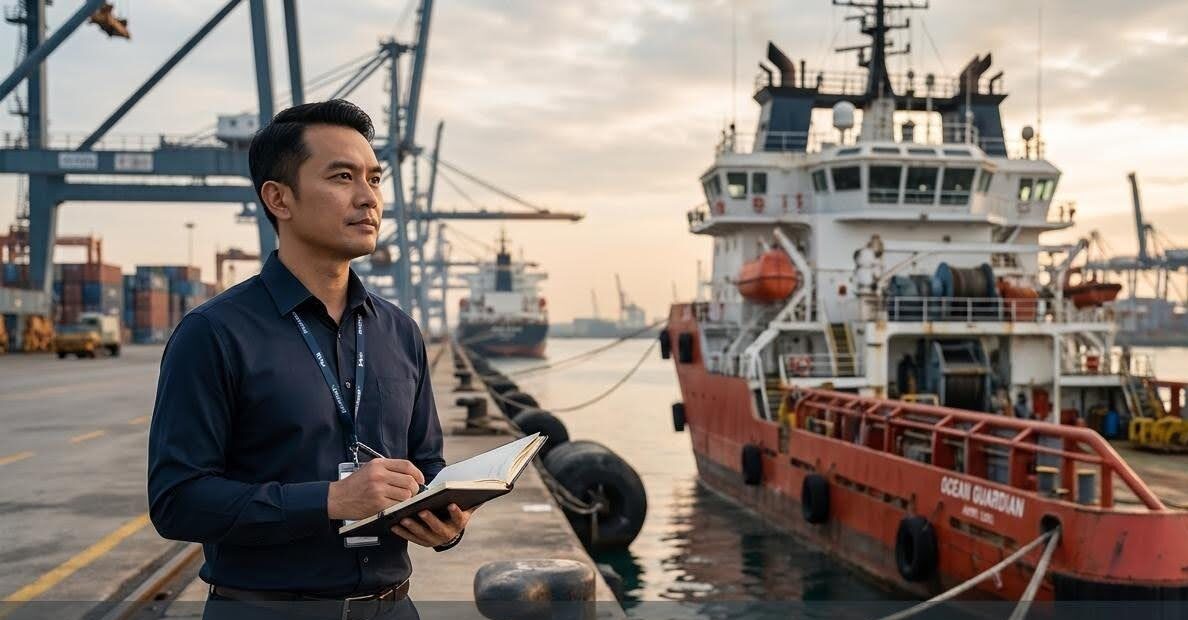
An anchor handling tug supply vessel berthed at Labuan, the operating base for the Malaysian offshore O&G fleet servicing the South China Sea fields.
Malaysia sits at the centre of one of the busiest shipping corridors in the world
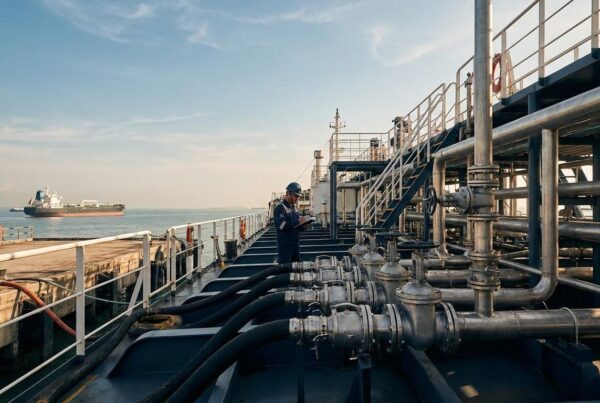
Port Klang and the Port of Tanjung Pelepas handle the bulk of the country’s container volumes. Labuan IBFC anchors the offshore oil and gas fleet that services the South China Sea and the Sabah coast. Kemaman, Lumut, and Bintulu are the operating bases for tugboats, anchor handling tug supply (AHTS) vessels, and offshore support vessels (OSVs) that work the Terengganu, Sarawak, and Sabah fields. Sandakan, Tawau, and Kuantan support the deep-sea fishing fleet and coastal trade. Across this geography, four scenarios drive most demand for vessel valuation in Malaysia: marine mortgage and bank financing, marine insurance hull and machinery cover, sale and purchase transactions, and mortgage default or admiralty disputes.
Vessel valuation is a specialised marine discipline. It isn’t real estate valuation with a hull. It isn’t plant and machinery valuation with a deck. A vessel valuer must read a classification certificate, understand drydocking and special survey cycles, distinguish a bareboat charter (BB) from a time charter (TC), interpret a deadweight (DWT) figure against a gross registered tonnage (GRT) figure, and read the freight market for the relevant vessel category. The methodology varies by vessel type. The market evidence varies by region and charter status. The depreciation curve varies by class status, drydocking date, and IMO regulatory exposure (MARPOL, BWMC, EEXI, CII).
This guide covers the full picture: when you need a vessel valuation, the three valuation methodologies that apply, the three pillars of vessel value (class, drydocking, charter status), the vessel categories MacReal values in Malaysia, the regional shipping markets, the four most common use cases (mortgage, insurance, S&P, default), what classification societies and IMO regulations do to value, the information request list a valuer needs, and how to choose a vessel valuer in Malaysia. It serves shipowners, bankers underwriting marine mortgages, marine insurers calculating sums insured, admiralty lawyers, and audit committees signing off on MFRS 13 fair value disclosures.
When You Need a Vessel Valuation
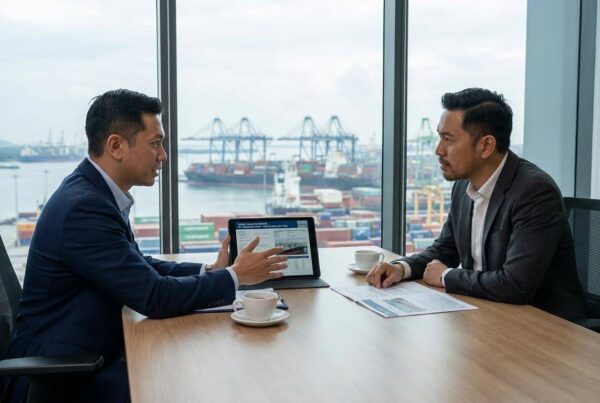
The Malaysian shipowner doesn’t commission a valuation for fun. There’s always a counterparty: a bank, an insurer, a buyer, a court, or an auditor. Six trigger events cover most of the demand.
Marine Mortgage and Bank Financing
Banks underwriting marine mortgages need an independent fair market value (FMV) and orderly liquidation value (OLV) at origination, and periodic re-valuations during the loan tenure. Loan-to-value ratios (LTV) for vessels in Malaysia typically sit lower than for landed property because vessels move, depreciate faster, and are exposed to flag, class, and IMO regulatory risk. A clean class certificate with a recent special survey supports a higher LTV. A vessel due for drydocking within 12 months supports a lower LTV. A detailed cluster article on marine mortgage valuation Malaysia covers this in depth.
Marine Insurance: Hull and Machinery Sums Insured
Marine insurers require an agreed value (AV) for hull and machinery (H&M) cover. Under-insurance leaves the shipowner short in a constructive total loss (CTL) scenario; over-insurance attracts unnecessary premium and can be challenged at claim time. The valuer establishes the agreed value at policy inception and at each renewal. For pleasure craft and yachts, the same principle applies.
Vessel Sale and Purchase (S&P)
Whether the sale uses BIMCO’s Saleform 2012, NSF 93, or a bespoke memorandum of agreement (MOA), both seller and buyer benefit from independent valuation evidence. The valuer establishes fair market value and, where relevant, separates hull from spares, bunkers, and lubricants. The buyer’s bank also requires it for the financing leg. See vessel sale and purchase valuation for the transaction-side detail.
Mortgage Default and Admiralty Disputes
When a shipowner defaults, the mortgagee bank’s options run from negotiated workout (extension, restructure) through to enforcement by admiralty arrest. In Malaysia, the High Court (Admiralty Jurisdiction) handles vessel arrests at Port Klang, Penang Port, Bintulu, Kuantan, and Labuan. The Marine Department of Malaysia and the Malaysian Maritime Enforcement Agency (MMEA) coordinate the practical aspects of arrest and detention. The valuer’s role is to establish the forced sale value (FSV), distinguish it from FMV explicitly, and address vessel condition under arrest. The court order setting the auction reserve price typically anchors on FSV. See vessel auction valuation Malaysia and admiralty valuation Malaysia for the methodology under arrest conditions.
M&A and Fleet Acquisition
When a shipping company is sold, the fleet is the dominant asset. Vessel-by-vessel valuation feeds into the enterprise value calculation. For listed shipowners, the gap between net asset value (NAV) and market capitalisation often turns on the fleet valuation methodology. For private fleet acquisitions, vessel valuation is a hard input to the share price.
MFRS 13 Fair Value and MFRS 16 Lease Accounting
Listed Malaysian shipping companies and their auditors require fair value measurement under MFRS 13 for impairment indicators and for assets held under finance lease or sale-and-leaseback structures. Bareboat charter-out arrangements may require fair value disclosures under MFRS 16. The valuer’s report must explicitly address the fair value hierarchy (Level 1, Level 2, Level 3) and the methodology used.
Vessel Valuation Methodologies: Market, DRC, and Income
The IVSC International Valuation Standards (IVS 2025) set out three approaches: market, cost, and income. All three apply to vessels, but the weight given to each depends on vessel type, age, charter status, and the depth of comparable evidence.
The Market Approach (Sales Comparison)
The market approach is the primary method for vessels with active secondary markets: bulk carriers, tankers, container ships, offshore support vessels, and tugboats. The valuer assembles recent sales of comparable vessels (same vessel type, similar deadweight or bollard pull, similar age, similar build country and class society), and adjusts for differences. Sources include Clarksons Research SIN database, VesselsValue, Affinity, S&P broker reports, and where applicable BIMCO market intelligence. For Malaysian-flagged vessels and tonnage trading in the region, broker desks in Singapore (Howe Robinson, Braemar, Simpson Spence Young, Compass Maritime) supply much of the comparable evidence.
The Cost Approach (Depreciated Replacement Cost or DRC)
The DRC approach builds up new building cost using current shipyard prices, then applies depreciation for chronological age, effective age, drydocking status, and economic and functional obsolescence. DRC is the dominant method for vessels with thin secondary markets: highly specialised offshore vessels, customised barges, government and patrol craft, and vessels in unusual configurations. It’s also used as a sanity check alongside the market approach for any vessel. Newbuilding price data comes from Clarksons SIN, Marine Money, and direct quotation from shipyards (Korean, Japanese, Chinese, and where relevant Malaysian yards such as Boustead Naval Shipyard or Brooke Dockyard for smaller tonnage).
The Income Approach (DCF for Chartered Vessels)
The income approach discounts the projected charter income net of operating expenses (OPEX), drydocking accruals, and a residual scrap value, back to present value at a market-based discount rate. It’s used primarily for vessels on long-term charter where the income stream is contractually committed (long-term TC, BBC with purchase option). It’s less reliable for spot-traded tonnage because the freight rate volatility makes the discount rate selection contentious.
In practice, MacReal applies all three approaches where data permits, reconciles the indications, and presents the conclusion with an explicit rationale for the chosen primary approach. The final valuation isn’t an average. It’s a reasoned conclusion that gives appropriate weight to the most reliable evidence.
The Three Pillars of Vessel Value: Class, Drydocking, and Charter Status
Three variables move vessel value more than any others. A valuer who doesn’t interrogate all three will produce a number that the bank, the insurer, or the buyer won’t trust.
Pillar 1: Classification Status
A vessel in class with a recognised classification society (Lloyd’s Register, ABS, DNV, Bureau Veritas, IRClass, NK, China Classification Society, Korean Register) carries a meaningful premium over a vessel out of class or with class suspended. Class status proves the vessel is structurally sound, mechanically operable, and has passed periodic surveys. Out of class means the bank won’t finance, the insurer won’t cover, and the buyer pool collapses to scrap or to the small group of operators willing to recommission.
Pillar 2: Drydocking and Special Survey Cycle
Vessels are surveyed on a five-year cycle. Years 1, 2, 3, and 4 carry annual surveys. Year 5 is the special survey, which requires a drydocking, hull inspection below the waterline, and major component overhaul. A vessel that has just completed its special survey carries a premium because the buyer inherits five years of clean operating life. A vessel one month away from special survey is discounted because the buyer absorbs the cost (RM 800,000 to RM 5 million depending on size and class society) and the off-hire days.
Pillar 3: Charter Status
A vessel under long-term TC or BBC with a creditworthy charterer carries a premium because the cash flows are visible and contractually committed. A vessel in lay-up or with no charter on the horizon is discounted. A vessel on spot trade is valued by reference to spot earnings forward curves and the freight rate volatility for that segment. The same hull, with three different charter arrangements, can support three meaningfully different valuations.
Vessel Categories MacReal Values in Malaysia
Vessel valuation isn’t generalist work. The methodology, market data sources, and technical adjustments differ by vessel type. MacReal covers the categories most relevant to Malaysian shipowners and their financiers.
- Tugboats
- Anchor Handling Tug Supply (AHTS) vessels
- Offshore Support Vessels (OSV)
- Tankers
- Bulk carriers
- Container vessels
- Fishing vessels
- Barges and workboats
- Pleasure craft and yachts
Container terminal operations at Westport, Port Klang. Container vessels in the feeder and intra-Asia trades are a recurring valuation segment for Malaysian operators.
Marine Mortgage Valuation: What Banks Look For
Banks underwriting marine mortgages in Malaysia (Maybank, CIMB, RHB, Public Bank, AmBank, Hong Leong, OCBC Malaysia, HSBC Amanah, Standard Chartered, MUFG Bank, plus Labuan offshore branches) work to a credit policy that requires:
- Independent valuation by a qualified marine valuer. Self-valuation by the broker arranging the deal isn’t acceptable.
- Fair Market Value (FMV) as the primary value, plus Orderly Liquidation Value (OLV) and Forced Sale Value (FSV) as secondary indications. The bank lends a percentage of FMV but stress-tests against OLV and FSV.
- Methodology disclosure. The valuer must state which approach was used (market, DRC, income), why, and what comparable data supported it.
- Class and survey status as at valuation date. Stale class certificates undermine the valuation.
- Charter status and residual term. A vessel with two years of TC remaining at attractive rates is a different credit than the same hull on spot.
- IMO regulatory exposure. EEXI and CII compliance status, BWMC retrofitted or not, MARPOL Annex VI compliance for sulphur cap. A non-compliant vessel may need substantial capex to remain operable.
- Periodic re-valuation. Most marine mortgage facilities require annual or semi-annual re-valuation, especially in volatile freight markets.
Marine Insurance Valuation: Setting the Hull and Machinery Sum Insured
Marine insurers in Malaysia (Etiqa General Insurance, Allianz General, Lonpac, MSIG, Tokio Marine, Pacific Insurance, AmGeneral, plus the Lloyd’s syndicates accessed through Malaysian brokers) underwrite hull and machinery (H&M) cover on an agreed value basis. The valuer’s role is to:
- Establish the agreed value (AV) that both insurer and shipowner accept as the basis of cover.
- Distinguish hull and machinery from increased value (IV), war risk, and loss of hire cover, each of which is a separate policy with its own sum insured logic.
- Address the constructive total loss (CTL) threshold, which is typically 75% to 100% of insured value depending on policy terms.
- Allow for spares, bunkers, and lubricants where the policy covers them separately.
- Update the AV at policy renewal, especially after drydocking, major capital expenditure, or significant freight market movement.
A vessel under-insured at renewal exposes the shipowner to a loss in the next CTL claim. A vessel over-insured pays unnecessary premium. The valuation is the link between the policy and reality.
Vessel Sale and Purchase Valuations
S&P transactions move the bulk of vessel value globally. For Malaysian shipowners, S&P falls into a few patterns:
- Domestic resale between Malaysian flag operators, often within the offshore O&G cluster (Labuan, Kemaman) or the coastal trade.
- Regional sale to ASEAN or East Asian buyers (Indonesia, Singapore, Vietnam, China, Korea), particularly for tankers, bulk carriers, and offshore vessels.
- Sale for scrap at Bangladesh (Chittagong), India (Alang), Pakistan (Gadani), or Turkey, applicable to end-of-life tonnage.
- Sale and leaseback (SLB) structures where a Malaysian shipowner sells to a leasing financier and bareboat charters back. SLB requires fair value evidence at the transaction date.
The valuer’s role in S&P is to provide independent fair market value evidence that supports the negotiated price, identify factors that justify a premium or discount, and where the buyer is financing through a Malaysian bank, deliver a report that meets the lender’s requirements directly so the same valuation supports both legs of the transaction.
Vessel Valuation in Mortgage Default and Admiralty Cases
When a shipowner defaults, the mortgagee bank’s options run from negotiated workout (extension, restructure) through to enforcement by admiralty arrest. In Malaysia, the High Court (Admiralty Jurisdiction) handles vessel arrests at Port Klang, Penang, Pasir Gudang, Bintulu, Kuantan, and Labuan. The Marine Department of Malaysia and the Malaysian Maritime Enforcement Agency (MMEA) coordinate the practical aspects of arrest and detention.
The valuer’s role in default and admiralty cases is to:
- Establish the forced sale value (FSV) assuming a constrained marketing period (often 3 to 6 months) and a buyer pool restricted to operators willing to take an arrested vessel with limited inspection access.
- Distinguish FSV from FMV explicitly. The court order setting the auction reserve price typically anchors on FSV.
- Address vessel condition under arrest, including layup deterioration, class lapse, and crew abandonment issues that affect realisable value.
- Where the vessel is at risk of port-state detention or has IMO regulatory liabilities (Paris MoU or Tokyo MoU detentions), build that into the value conclusion.
For lawyers handling the admiralty matter, the valuation evidence is part of the pleadings and the ultimate court order.
Classification Society Status and Vessel Value
The major classification societies recognised under the International Association of Classification Societies (IACS) all carry industry-standard weight: Lloyd’s Register (LR), American Bureau of Shipping (ABS), DNV (formerly DNV GL), Bureau Veritas (BV), Indian Register of Shipping (IRClass), Nippon Kaiji Kyokai (NK or ClassNK), Korean Register (KR), China Classification Society (CCS), Polski Rejestr Statkow (PRS), Russian Maritime Register of Shipping (RS), Croatian Register (CRS), and Registro Italiano Navale (RINA). Most Malaysian-flagged tonnage carries LR, ABS, DNV, BV, NK, or IRClass.
The class certificate is the proof that the vessel has met the survey programme. Class status moves through three states:
In class. Surveys current, no overdue conditions of class, no outstanding recommendations of consequence. Full marketability.
Class suspended. Surveys overdue or significant unrepaired damage. Marketability collapses; insurance and finance are typically withdrawn.
Class withdrawn. The vessel is no longer classed. Recovery requires reclassification, a costly process. The buyer pool is restricted to operators willing to invest in reclassification.
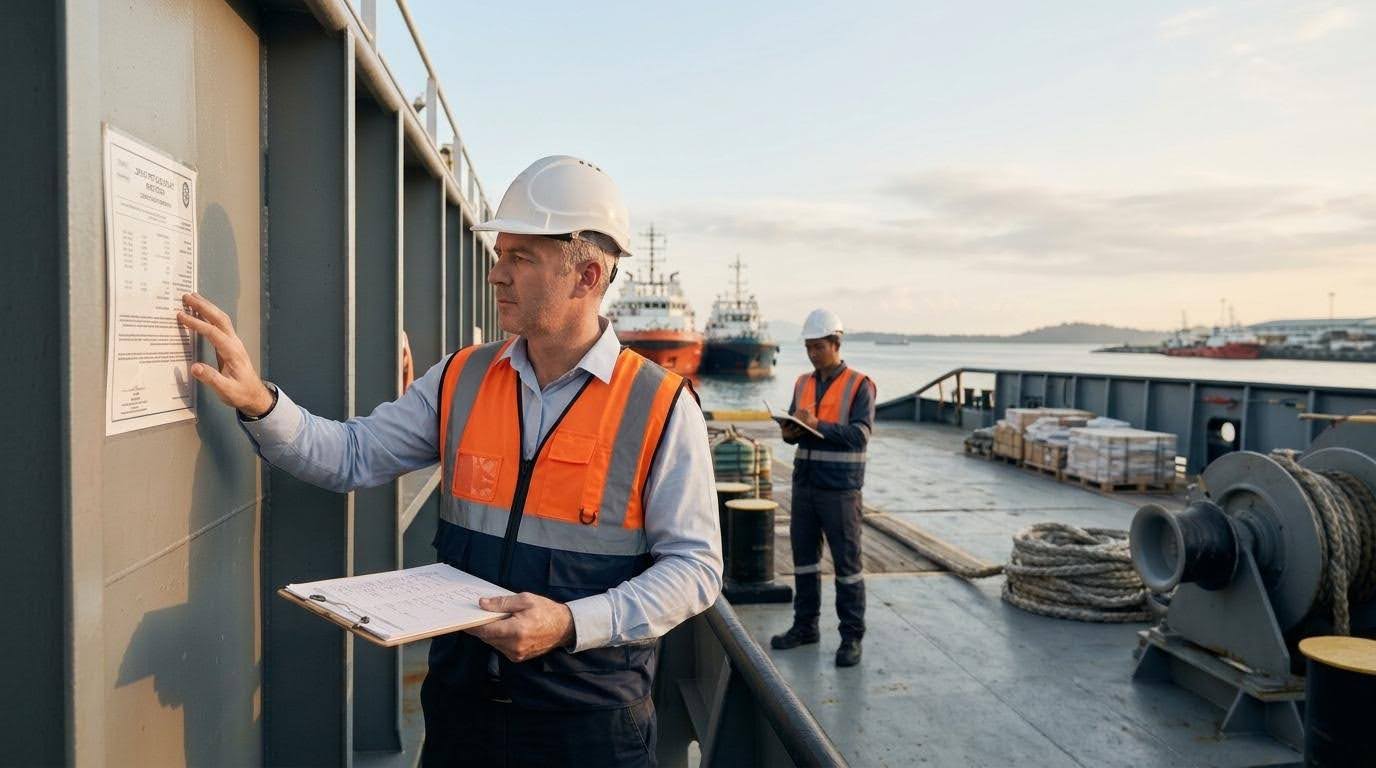
A vessel valuer must verify class status at valuation date, list any conditions of class or recommendations, and reflect the impact in the value conclusion. Misreporting class status is one of the largest causes of valuation report rejection by banks.
IMO Regulations and Their Impact on Vessel Value
The International Maritime Organisation (IMO) sets the regulatory framework that all internationally trading vessels must comply with. Three regulatory streams currently move vessel value materially.
MARPOL Annex VI (Sulphur Cap and Air Emissions)
The 0.50% global sulphur cap (effective January 2020) divided the world fleet between vessels that installed exhaust gas cleaning systems (scrubbers) and vessels that switched to compliant low-sulphur fuel. Scrubber-fitted tonnage commands a premium when the spread between high-sulphur fuel oil (HSFO) and very low-sulphur fuel oil (VLSFO) is wide, and a discount when the spread compresses. The Emissions Control Areas (ECA) carry a stricter 0.10% sulphur limit; vessels trading into ECAs need additional compliance equipment or fuel switching capability.
Ballast Water Management Convention (BWMC)
In force since 2017, BWMC requires installation of a Ballast Water Treatment System (BWTS) by the first IOPP renewal after 8 September 2019. Vessels that have already retrofitted BWTS carry a premium of the retrofit cost (USD 1 million to USD 5 million depending on vessel size). Non-retrofitted vessels are discounted by the same amount. For Malaysian-flag and regional trade tonnage, BWTS retrofit status is a hard line item in any valuation.
EEXI, CII, and the IMO GHG Strategy
The Energy Efficiency Existing Ship Index (EEXI) and Carbon Intensity Indicator (CII) regulations entered force in 2023. Vessels are rated A through E on CII; D and E ratings trigger a corrective action plan and progressively restrict commercial deployment. Older, less efficient vessels face accelerating commercial obsolescence. The IMO 2050 net-zero strategy and the EU Emissions Trading System (EU ETS) extension to maritime add further regulatory pressure. A valuer looking at older tonnage must address regulatory obsolescence explicitly.
The Vessel Information Request List
To produce a defensible valuation, MacReal needs the following from the shipowner or instructing party at engagement.
Vessel particulars and certificates
- Builder, hull number, year built, country of build
- IMO number, MMSI, call sign
- Flag and port of registry
- Classification society and class notation
- Class certificate (current), class survey status report
- International Tonnage Certificate (ITC), International Load Line Certificate
- IOPP, IAPP, BWM, ISM, ISPS, MLC certificates
- Continuous Synopsis Record (CSR)
- Statement of Compliance for SEEMP, EEXI Technical File, CII rating
Operational and commercial data
- Charter party (current), charterer name, daily hire rate or freight rate, charter expiry
- Last drydocking date, scope of work, cost
- Next due drydocking and special survey dates
- Any conditions of class, recommendations, or notations
- Any port-state detention history (Paris MoU, Tokyo MoU, USCG)
- Any unrepaired damage, casualty history, or outstanding repair items
Technical
- General arrangement (GA) drawing, capacity plan, hydrostatic curves
- Main engine make, model, year, hours, last overhaul
- Auxiliary engines, generator sets, key deck machinery
- For OSVs, AHTS, and PSVs: bollard pull certificate, deck cargo capacity, DP notation
- For tankers: cargo tanks, coatings, double hull date, MARPOL category
Insurance and financial
- Current H&M sum insured and renewal terms
- Existing mortgage details (if any)
- Recent valuations (for comparison and continuity)
A complete information pack accelerates the valuation; gaps require physical inspection or third-party verification, both of which add cost and time.
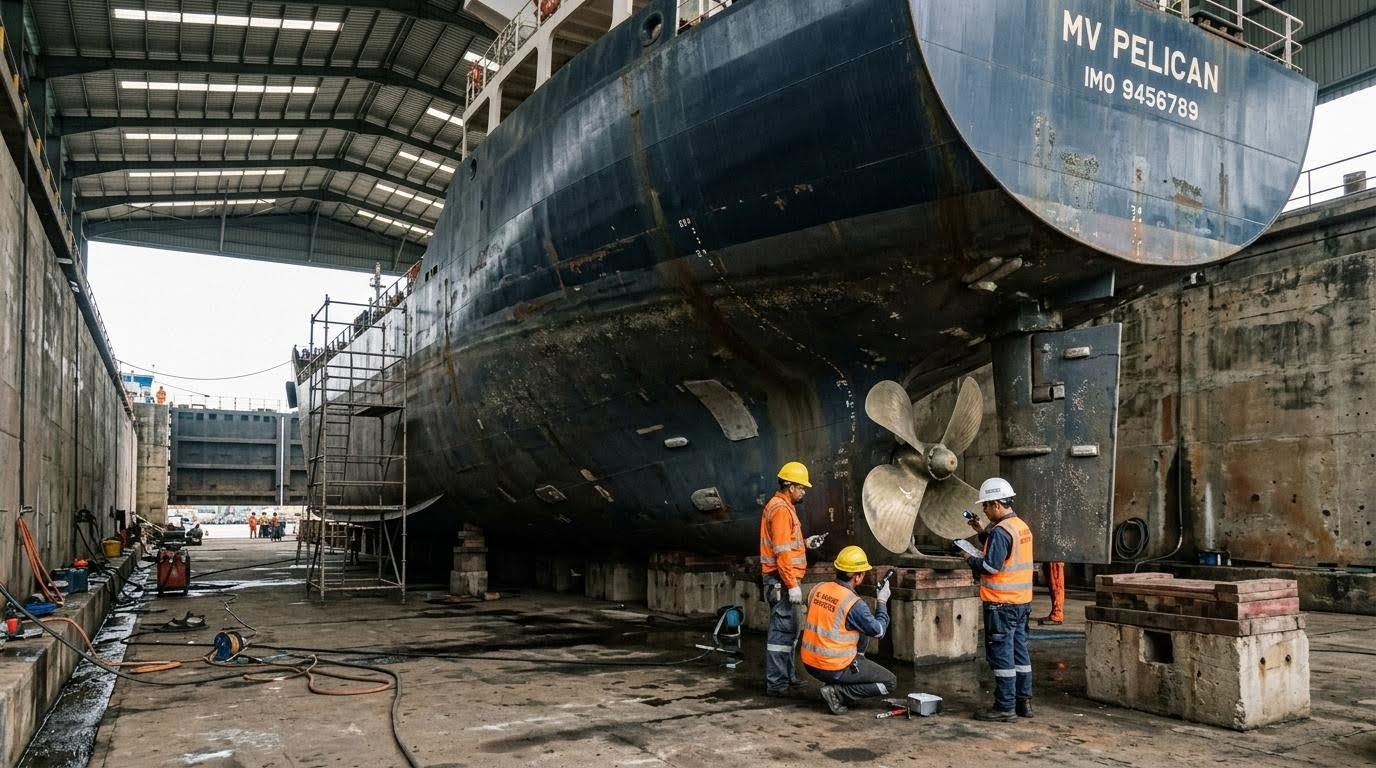
A vessel in drydock for special survey, hull inspection, and major component overhaul. Drydocking status is one of the three pillars driving vessel value.
How Much Does Vessel Valuation Cost in Malaysia
Vessel valuation fees in Malaysia depend on vessel type, size, methodology required, scope (desktop versus full physical inspection), report complexity, and turnaround. Indicative bands at 2026 prices:
- Small craft (under 100 GRT) including small tugs, fishing vessels, pleasure craft: from RM 5,000 for desktop valuations.
- Medium tonnage (100 to 5,000 GRT) including tugs, AHTS, OSVs, smaller tankers, coastal bulk carriers: RM 12,000 to RM 30,000.
- Larger tonnage (above 5,000 GRT) including larger tankers, bulk carriers, container vessels, specialised offshore tonnage: RM 25,000 to RM 80,000.
- Yacht and pleasure craft by hull length and complexity: RM 8,000 to RM 25,000.
- Mortgage default, admiralty, and contested matters carry a premium for forensic depth, expert witness preparation, and court attendance: typically 50% to 100% above the base fee.
- Physical inspection add-on (travel and surveyor day rates): RM 3,000 to RM 15,000 depending on location (Labuan, East Malaysia, regional ports).
Choosing a Vessel Valuer in Malaysia
Vessel valuation is a regulated and credentialed discipline. When selecting a valuer for a Malaysian engagement, look for the following.
Standards Alignment
The valuer should produce reports compliant with the IVSC International Valuation Standards (IVS), with explicit reference to IVS 105 (Valuation Approaches and Methods) and IVS 220 (Plant, Equipment, and Machinery). For Malaysian audit and listed-company contexts, MFRS 13 fair value disclosures must be addressed.
Credentials
Look for valuers with marine valuation credentials: BOVAEP, Lloyd’s Maritime, IACVA accreditation, RICS Registered Valuer status with marine experience, or equivalent. For court matters, prior expert witness experience is a hard requirement.
Marine Domain Experience
Valuing a vessel isn’t a clerical exercise. The valuer should be able to read class certificates, interpret survey programmes, navigate IHS Maritime and Lloyd’s List Intelligence data, and engage with regional broker desks. Demand evidence of past engagements in the relevant vessel category.
Local Knowledge
For Malaysian engagements, knowledge of Labuan IBFC structures, the Malaysian Marine Department flagging process, MMEA enforcement context, the High Court (Admiralty Jurisdiction) procedural regime, and the Malaysian banking environment matters. A foreign valuer can produce a technically correct report that misses the local context the bank or court actually needs.
Independence
The valuer must not be the broker arranging the sale, the lender financing the purchase, the lawyer handling the dispute, or the insurance broker placing the cover. Independence is a regulatory and reputational requirement.
Get a Vessel Valuation Quotation
If you’re arranging a marine mortgage, renewing a hull and machinery policy, negotiating a vessel sale, defending or pursuing an admiralty matter, or signing off on an MFRS 13 fair value disclosure, MacReal can support you with an IVSC-compliant vessel valuation report.
To request a fee quotation, share the basic vessel particulars (vessel name, IMO number, vessel type, year built, gross tonnage or deadweight, class society, current location and charter status) and the purpose of valuation. We respond with a fee quotation within 24 hours.
MacReal International is a Malaysian valuation firm operating under IVSC and IACVA standards, with credentialed valuers covering business valuation, plant and machinery valuation, and vessel valuation across the Malaysian and regional markets.