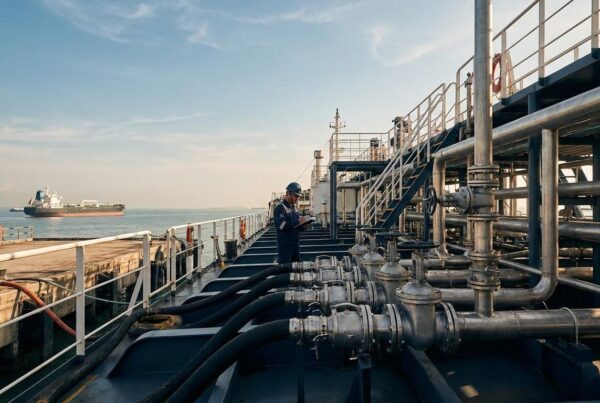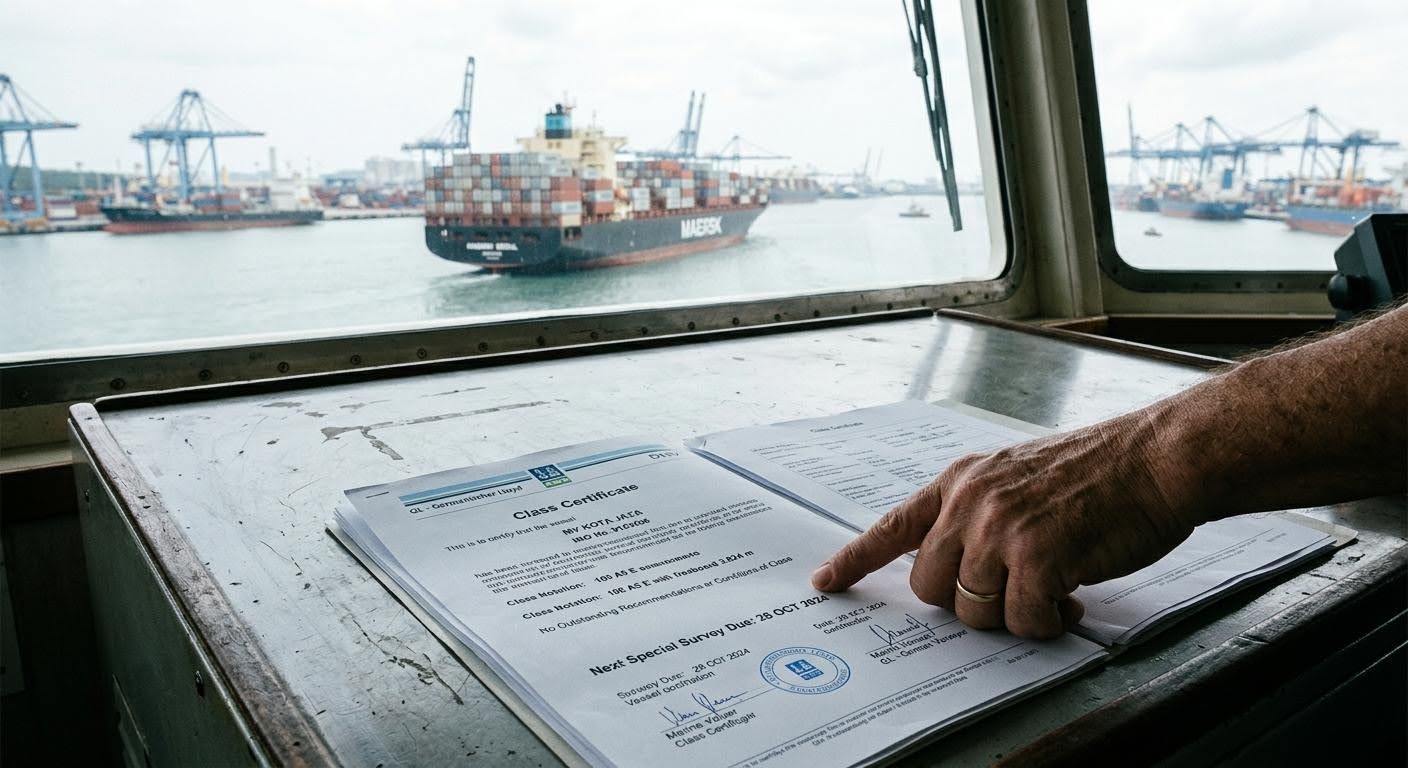
This article is for the financier looking at a vessel report that flags a class condition, the P&I underwriter pricing renewal, or the owner who has just had a survey go badly. Class status is the single biggest binary driver of vessel value: a ship out of class trades at scrap, while a ship in good standing with a recognised society trades at full market value. The takeaway is a clear map of how each class state, condition of class, and port state record affects the valuation methodology and the report wording a Malaysian valuer will use.
Why Class Sits at the Core of Vessel Value
A classification society is the technical authority that certifies a vessel is built and maintained to published rules covering hull, machinery, electrical systems, and key equipment. Banks, insurers, charterers, and flag administrations all rely on that certification. Without it, a vessel cannot trade internationally, cannot be insured at hull value, and cannot be mortgaged at anything close to market price.
Class is therefore not a soft factor that can be discounted with a small percentage adjustment. It is a gate. A vessel either holds class with a recognised society or it does not, and that single fact determines whether the valuation runs on a market-comparison basis or on a scrap-value basis. Everything else, including age, drydocking history, charter book, and machinery condition, sits on top of that gate.
For Malaysian owners, the practical implication is that class status is the first item every valuer, lender, and underwriter will check before any commercial discussion begins.
IACS Members and Their Position in Malaysia
The International Association of Classification Societies (IACS) is the umbrella body for the eleven societies that handle the bulk of the world’s classed tonnage. As of the current IACS membership, the eleven members are the American Bureau of Shipping (ABS), Bureau Veritas (BV), the China Classification Society (CCS), the Croatian Register of Shipping (CRS), DNV, the Indian Register of Shipping (IRS), the Korean Register (KR), Lloyd’s Register (LR), Nippon Kaiji Kyokai (ClassNK), the Polish Register of Shipping (PRS), the Russian Maritime Register of Shipping (RS), and RINA. Source: IACS, Members, iacs.org.uk.
These societies are the only ones that participate in IACS Unified Requirements, the harmonised technical floor that governs hull strength, common structural rules for tankers and bulkers, and joint approaches to safety. For a Malaysian buyer, the practical signal is that an IACS class certificate is universally accepted by P&I clubs, mortgage banks, and major charterers. A non-IACS class certificate is not.
For Malaysian-flag tonnage, the dominant societies are LR, ABS, BV, ClassNK, and DNV for ocean-going vessels, with IRS taking a growing share of mid-size domestic fleets and offshore support vessels. Labuan IBFC, Malaysia’s offshore corporate and shipping register, hosts a heavy concentration of LR, ABS, and DNV tonnage because international financiers require those names. KR and ClassNK are common on Korean-built and Japanese-built ships that come into Malaysian ownership through second-hand sale.
Non-IACS societies do exist and operate legally, but for valuation purposes they are treated as a different category. A vessel classed with a non-IACS society typically trades at a 5 to 15 percent discount to a comparable IACS-classed sister, because the next buyer will need to switch class to obtain mainstream financing or insurance. The valuer will price that switch cost into the report.
Class States and Value Impact
Class is not a single binary. There are four operational states a vessel can sit in, and each one drives a distinct valuation outcome.
In class, no conditions, no overdue surveys. This is the clean state. The vessel is fully certified, all periodic surveys are current, and no conditions of class are recorded. The valuer can apply full market value using sale-and-purchase comparables. This is the baseline assumption for any IVSC-aligned market value.
In class with conditions of class. A condition of class (sometimes written as “memorandum” or “recommendation” depending on the society) is a defect or non-compliance the surveyor has identified, with a deadline by which it must be rectified. The vessel keeps trading, but the open condition is recorded on the class certificate. Valuation in this state is market value less the cost to clear each condition, plus any time-value adjustment if the deadline forces a near-term docking. For minor conditions, the impact is small. For structural or main-engine conditions, the impact can run into the hundreds of thousands of ringgit and may pull the vessel into an unscheduled drydock. See Drydocking and Vessel Valuation for the docking-cost methodology.
Class suspended. Suspension occurs when the owner misses a survey deadline, fails to clear a condition by its due date, or has an accident the society treats as a major incident. The vessel cannot trade in most jurisdictions while suspended. Valuation in this state applies a forced-sale discount of typically 25 to 40 percent off market value, because the next buyer must restore class before earning revenue. The discount widens if the suspension has been in place for more than a few weeks, because owners under suspension are usually under financial stress.
Class withdrawn or vessel out of class. Withdrawal is the terminal class state. The society has formally cancelled the certificate, usually because the owner has not paid fees for an extended period, has failed to present the vessel for survey, or has been removed for non-compliance. A vessel out of class trades at scrap value, which means light displacement tonnage multiplied by the prevailing demolition price at Indian, Bangladeshi, or Pakistani recycling yards, less towage to the yard. There is no realistic market value above scrap.
The discontinuity between “in class with conditions” and “class suspended” is the cliff that catches owners and lenders by surprise. The vessel can move from a 95 percent value state to a 60 percent value state in a single missed deadline.
How Valuers Treat Class Conditions
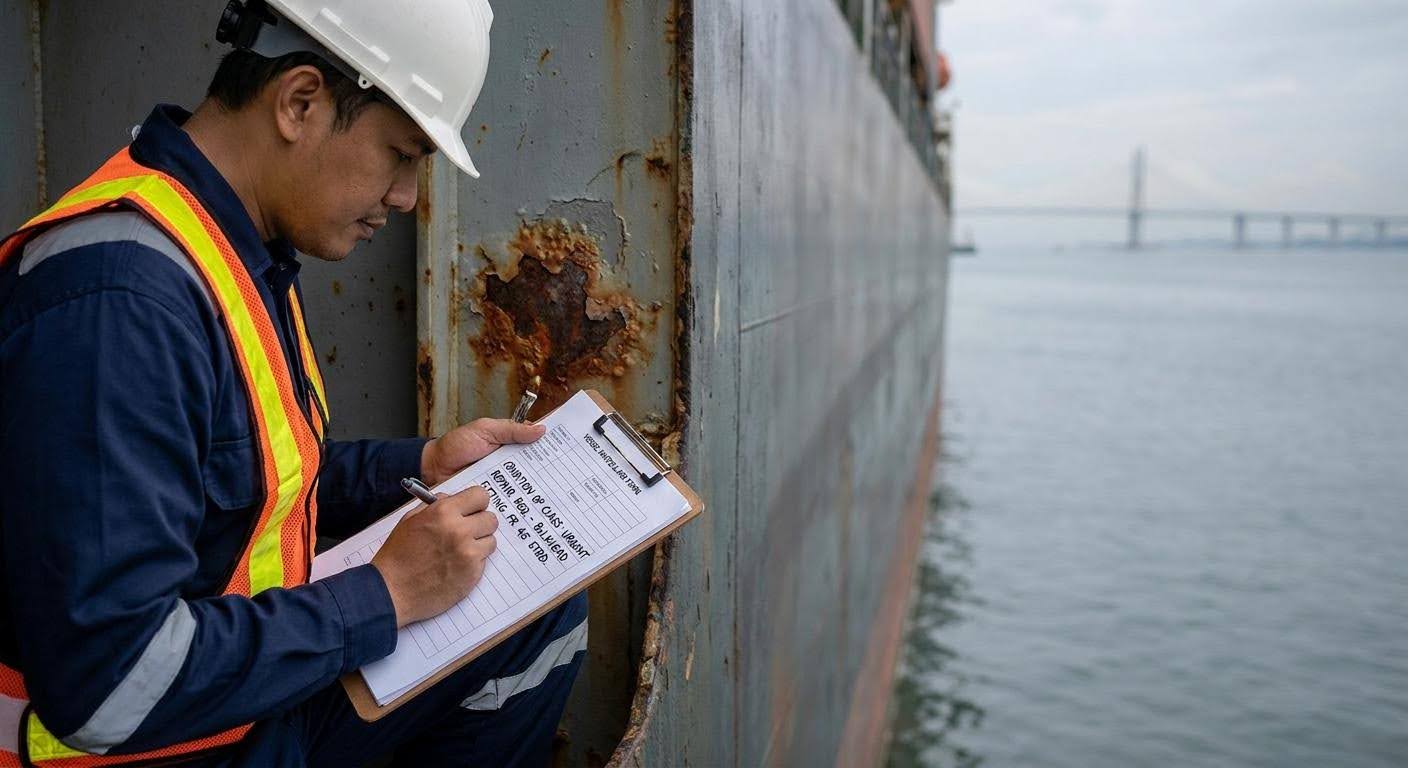
The valuer’s job in a class-conditioned valuation is to identify each condition, price it, and disclose it. The process runs in three steps.
Identification. The valuer requests the current class status report from the society or from the owner, listing every open condition, the deadline, and the surveyor’s notes. For Malaysian-flag vessels the report comes through the society’s local office (LR Malaysia, ABS Singapore covering Malaysia, BV Kuala Lumpur, ClassNK Singapore, IRS Malaysia). The valuer does not rely on the owner’s verbal summary. The class status report is the source document.
Pricing. Each condition is costed using the cleared rate for that work item: steel renewal in ringgit per tonne at the local yard, main-engine bearing replacement at OEM rates, gas-detection retrofit at vendor quotation. Where the condition forces an unscheduled drydock, the valuer adds dock days, off-hire revenue loss, and mobilisation cost. The pricing is conservative because the buyer’s surveyor will discover the same items.
Disclosure. The report names each condition, its deadline, the cost to clear, and the impact on the reported value. IVSC International Valuation Standards require a clear disclosure of any constraint on the asset’s marketability, and class conditions sit squarely inside that requirement. Source: IVSC, International Valuation Standards, IVS 105 Valuation Approaches and Methods.
A second factor that sits alongside class is the port state control (PSC) record. Tokyo MOU, Paris MOU, and US Coast Guard inspection histories are public and easily searchable. A vessel with multiple recent detentions, particularly for ISM or structural deficiencies, attracts scrutiny from financiers and a discount from buyers even where class is technically clean. Source: Tokyo MOU, Inspection Search, tokyo-mou.org. The valuer treats a poor PSC record as evidence that the operator is under-investing, which compresses the reported value by 3 to 8 percent depending on severity.
Re-Class, Society Switches, and Recovery Paths
Recovery from a bad class state is possible, and the valuer must understand the path before pricing the vessel.
Switching society while in class. An owner can switch from one IACS society to another at any time, typically at a major periodic survey such as the five-yearly special survey. The receiving society conducts a transfer-of-class survey and issues a new certificate. The switch typically costs RM 50,000 to RM 250,000 depending on vessel size, plus the survey time. Value impact is usually neutral, provided both the old and new society are IACS members. If the move is from non-IACS to IACS, the valuer reports a value uplift once the transfer is complete.
Restoring class after suspension. The owner clears the outstanding items, presents the vessel for inspection, and pays reinstatement fees. The vessel returns to “in class with conditions” or “in class clean” depending on what was cleared. The valuation moves back up the curve as soon as the certificate is reissued. The valuer will require sight of the new certificate before reporting full market value.
Restoring class after withdrawal. This is harder and slower. The owner must apply for new entry, which often requires a full intermediate or special survey, drydocking, and structural verification depending on the time the vessel has been out of class. For older tonnage that has been out of class for more than 12 months, the cost of return often exceeds the value uplift, and the owner sells for scrap instead. The valuer reports scrap value with a note on the theoretical reinstatement path.
Flag implications. A change of class often comes with a change of flag. Malaysian-flag vessels that move to Labuan IBFC or to international flags such as Singapore, Marshall Islands, or Panama trigger a separate set of compliance and tax considerations. Class and flag are independent in principle but tightly coupled in practice. See IMO Regulations and Vessel Value (Link) for the regulatory dimension and the parent guide Vessel Valuation Malaysia: Complete Guide (Link) for the full methodology context.
Closing
Class status is the gate every Malaysian vessel valuation runs through. An IACS class certificate in clean standing supports full market value. Conditions of class compress that value by their cost to clear. A suspension knocks 25 to 40 percent off. A withdrawal pulls the vessel down to scrap. The valuer’s job is to identify the state precisely, price each condition, document the port state record, and disclose all of it in the report so the lender, buyer, or P&I underwriter can act on a clear picture.
Request a MacReal vessel valuation fee proposal that addresses class status explicitly, and MacReal will document each condition, each survey overdue, each port state finding, and the value impact of each, in a report aligned to IVSC standards and accepted by Malaysian banks and international P&I clubs.