When a bank, shipowner, or maritime lawyer needs a credible vessel opinion, the valuer behind the report matters as much as the number on the page. A poorly credentialled opinion can derail a marine mortgage application, stall an admiralty proceeding, or expose a buyer to undisclosed liabilities. Understanding vessel valuation in Malaysia is the starting point, but understanding who is qualified to provide that valuation is the step that actually protects you.
This guide walks through the criteria a shipowner, financier, or legal counsel should apply when selecting a vessel valuer in Malaysia, from professional credentials and track record to engagement-letter requirements and the red flags that should prompt you to look elsewhere.
Marine Surveyor vs Vessel Valuer: Two Different Roles
The most common source of confusion in the maritime services market is the conflation of marine surveyors with vessel valuers. The two roles overlap in some firms, but they are professionally distinct.
A marine surveyor inspects a vessel’s physical condition: hull integrity, machinery function, safety equipment compliance, and flag-state readiness. Surveyors are typically credentialled through classification societies such as Nippon Kaiji Kyokai (NK), the American Bureau of Shipping (ABS), Lloyd’s Register (LR), Det Norske Veritas (DNV), or Bureau Veritas (BV). Their reports describe the physical state of the vessel at a point in time and do not express an opinion on monetary value.
A vessel valuer determines the economic worth of a vessel as at a specified valuation date. This requires comparable transaction data, freight market intelligence, newbuilding and scrap benchmarks, flag and class adjustments, and an understanding of how buyers and sellers in the relevant segment actually transact. The valuer uses survey findings as input, but valuation methodology and professional accountability are separate.
Banks accepting a vessel valuation report for marine mortgage security, and courts considering vessel valuations in admiralty proceedings, increasingly require the valuer to demonstrate adherence to an internationally recognised standard. The International Valuation Standards Council (IVSC) publishes IVS 102 on Investigations and Compliance, which requires valuers to disclose any matter that could compromise independence and to conduct appropriate investigations before expressing an opinion. IVSC Professional Membership signals the firm has committed to these standards. The International Association of Consultants, Valuators and Analysts (IACVA) offers a Certified Valuation Analyst (CVA) designation covering valuation methodology and professional ethics.
Where a firm holds both survey and valuation credentials, confirm that the person signing the valuation report holds valuation credentials specifically.
Credentials to Ask For
Before engaging any vessel valuer in Malaysia, request evidence of the following:
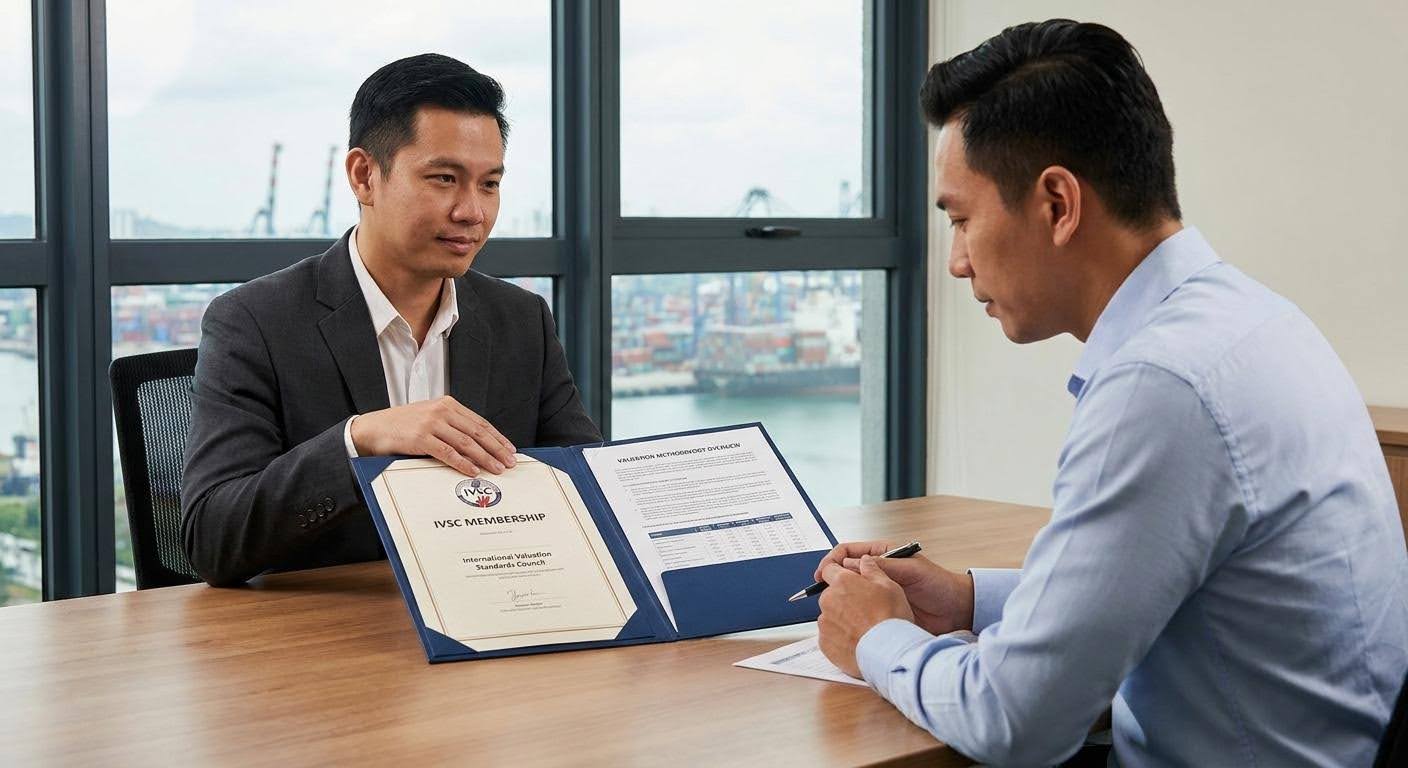
IVSC Professional Membership. A firm or individual holding IVSC Professional Membership has accepted the obligation to comply with the International Valuation Standards. For marine assets, compliance with IVS 102 on investigations and IVS 300 on plant and equipment (which covers vessels) is the baseline expectation for bank-panel and court-accepted reports.
IACVA CVA Designation. The IACVA Certified Valuation Analyst credential validates valuation methodology competence across asset classes, including marine assets. CVAs are bound by a code of professional ethics and continuing education requirements. For Malaysia-based engagements, ask whether the CVA is current and request the certificate of standing.
Classification Society Exposure. A credible vessel valuer will have worked alongside the classification society framework. Familiarity with NK, ABS, LR, DNV, or BV survey reports is essential for interpreting condition adjustments correctly. Ask the valuer to explain how they treat class deficiencies and overdue survey items in their comparable adjustments.
Ship Sale and Purchase Broker Exposure. The vessel market is a principal-to-principal market where value is established by negotiation between informed buyers and sellers, often intermediated by ship brokers. A valuer who cannot demonstrate familiarity with the S&P broking world, or who cannot name the primary Baltic and Clarkson indices they reference, is unlikely to have the comparable transaction data a robust valuation requires.
RICS or RISM Membership (Where Applicable). The Royal Institution of Chartered Surveyors (RICS) offers a valuation pathway covering marine and specialist assets under the Red Book global standards. The Royal Institution of Surveyors Malaysia (RISM) is the primary professional body for registered valuers in Malaysia. RISM membership is most relevant for valuers who also handle real property, but it signals baseline commitment to professional standards and continuing development.
Track Record Questions
Credentials establish minimum qualification. Track record establishes whether the valuer can actually do the work your specific situation requires. Ask the following:
Vessel types covered. Malaysia’s maritime economy spans OSVs, AHTSs, tankers, bulk carriers, tugboats, barges, fishing vessels, and container feeders. The valuation approach for a 10,000 DWT chemical tanker is materially different from that for a 5,000 BHP AHTS. Request a list of vessel types the firm has valued in the past three years, with reference contacts available on request.
Transaction-volume comparables database. A competent vessel valuer maintains or subscribes to a proprietary or third-party comparable transaction database. Ask which data sources they use, how frequently the database is updated, and how they handle thin market conditions where comparables are sparse. The answer will tell you whether the firm has real research capability or relies on public indices alone.
Ports and flags covered. Malaysian shipowners operate under the Marine Department of Malaysia registry, Labuan, and international open registries. The valuer should understand how flag affects insurability, mortgageability, and buyer pool, and should have experience with vessels trading across Peninsular Malaysia, Sabah, Sarawak, and international routes.
Marine mortgage and admiralty experience. If your purpose is bank financing or legal proceedings, confirm that the valuer has produced reports accepted by Malaysian licensed banks and, where relevant, reports submitted to the Admiralty Court. Ask for redacted examples and confirm whether any report has been successfully challenged in court.
Independence and Conflict Checks
A vessel valuation report is only as credible as the independence of the valuer. Conduct these checks before signing an engagement letter.
Confirm the valuer holds no financial interest in the vessel, the owning entity, or any related party such as the charterer, insurer, or broker. IVSC IVS 102 requires disclosure of any such interest; if the valuer cannot produce a written conflicts declaration, treat it as a red flag.
Where the valuation is for a marine mortgage, confirm that the valuer is not simultaneously acting as the S&P broker for the same transaction. Dual roles create an incentive to support a price that closes the deal rather than to report an independent opinion.
For admiralty proceedings, the court will scrutinise independence. The valuer should confirm they have no relationship with either party beyond the specific engagement.
Ask the firm to provide a copy of their professional indemnity (PI) insurance certificate. Adequate PI cover is a baseline requirement and a proxy for professional standing: underwriters will not extend cover to firms operating without recognised credentials or professional processes.
Fee Structure Benchmarks

Vessel valuation fees in Malaysia vary by vessel type, report scope, and the purpose of the valuation. The following ranges are indicative as at 2026:
For a single small vessel (tug, barge, or fishing vessel below 500 GT), a desktop valuation typically ranges from RM 2,500 to RM 5,000. A full inspection-based report suitable for bank mortgage purposes typically ranges from RM 5,000 to RM 10,000.
For mid-range commercial vessels (OSVs, small tankers, bulk carriers between 500 GT and 10,000 DWT), fees typically range from RM 8,000 to RM 20,000 depending on complexity and report deliverables required.
For large or specialist vessels (large tankers, offshore construction vessels, dredgers, or vessels with complex charter arrangements), fees are negotiated based on scope and may exceed RM 30,000 for a fully documented, methodology-disclosed report.
Beware of unusually low quotes. A fee significantly below market typically signals a desktop approach passed off as an inspection-based opinion, or a report recycled from a prior engagement without fresh market research.
Engagement-Letter Must-Haves
A properly structured engagement letter protects both the engaging party and the valuer. Before instructing any vessel valuer in Malaysia, confirm the engagement letter includes each of the following:
Scope of work. State precisely which vessel or fleet is being valued, the basis of value (Market Value, Forced Sale Value, or Insurance Value), and the purpose (mortgage, sale, litigation, financial reporting, or other).
Deliverable specification. Confirm whether the output is a full valuation report or a restricted-use certificate, whether a physical inspection is included, and the format and language of the final report.
Methodology disclosure. The engagement letter should commit the valuer to disclosing the methodology used in the report, including the comparable transactions or market references relied upon, any adjustments applied, and the weight given to each approach.
Valuation date. Vessel market values are highly sensitive to freight market cycles. The valuation date must be stated precisely, and the report should contain a statement that the opinion reflects market conditions as at that date only.
Basis of value. Market Value under IVSC standards is the price between willing, knowledgeable, and unpressured parties in an arm’s length transaction. If the bank requires Forced Sale Value, confirm this is specified separately with the applicable discount methodology disclosed.
Professional indemnity cover. The engagement letter should confirm the valuer’s PI insurance is in force and the sum insured is adequate for the instruction value.
Delivery timeline. Confirm the agreed dates for the draft and final report, and the process for responding to factual queries before issue.
Red Flags: When to Look Elsewhere
The following indicators suggest a vessel valuer may not be suitable for a credible, third-party-accepted engagement:
No IVSC compliance statement. A valuer who cannot confirm compliance with IVSC standards is operating outside the globally accepted framework. For bank mortgage and court purposes in Malaysia, this is increasingly disqualifying.
No proprietary comparable database. A valuer who relies entirely on published indices such as the Baltic Exchange cannot adequately support their opinion. Published indices reflect freight market sentiment; they are not a substitute for vessel transaction data.
No physical inspection visit. A valuation for mortgage or legal purposes that does not include a physical inspection, or at minimum a documented review of a recent condition survey, is unlikely to withstand scrutiny from a bank credit officer or court expert.
Unwillingness to disclose methodology. If a valuer declines to explain how they arrived at their figure, the opinion has no analytical foundation a third party can evaluate. This is inconsistent with professional standards under IVSC and IACVA frameworks.
No professional indemnity cover. The absence of PI cover is a liability risk for the engaging party and a strong signal that the valuer does not operate under recognised professional oversight.
Valuations outside the firm’s vessel type experience. A firm with a track record in OSV valuations that is asked to value a heavy-lift crane vessel or FPSO should disclose experience limitations and engage specialist support. A firm that does not acknowledge this gap warrants caution.
Valuer-Selection Checklist
Use this checklist when evaluating any vessel valuer in Malaysia before engagement:
- [ ] IVSC Professional Membership confirmed in writing
- [ ] IACVA CVA designation current
- [ ] Classification society survey framework experience (NK, ABS, LR, DNV, BV)
- [ ] S&P broker market exposure confirmed
- [ ] RICS or RISM membership checked
- [ ] Track record in the specific vessel type, references available
- [ ] Proprietary or subscribed comparable transaction database confirmed
- [ ] Ports, flags, and trading routes relevant to the vessel covered
- [ ] Marine mortgage reports accepted by Malaysian licensed banks
- [ ] Admiralty court experience (for litigation instructions)
- [ ] Written conflicts declaration provided
- [ ] Professional indemnity certificate provided
- [ ] Engagement letter covers scope, deliverable, methodology, valuation date, basis of value, and PI cover
- [ ] Fee quote consistent with market benchmarks
Conclusion
The quality of a vessel valuation depends directly on the credentials, independence, and market access of the valuer. In Malaysia’s maritime financing and legal environment, an opinion from an unqualified or conflicted source carries real commercial and legal risk for shipowners, bankers, and lawyers alike. Applying the criteria above before engagement, rather than after a report is delivered, saves time, cost, and the risk of an opinion that does not hold under scrutiny.
If your engagement requires a vessel valuation report for bank submission or a vessel valuation for a marine mortgage, MacReal International’s vessel valuation team holds IVSC and IACVA credentials and has produced reports accepted by Malaysian licensed banks and in admiralty proceedings. Contact us to discuss your instruction and receive a scope-specific fee proposal.