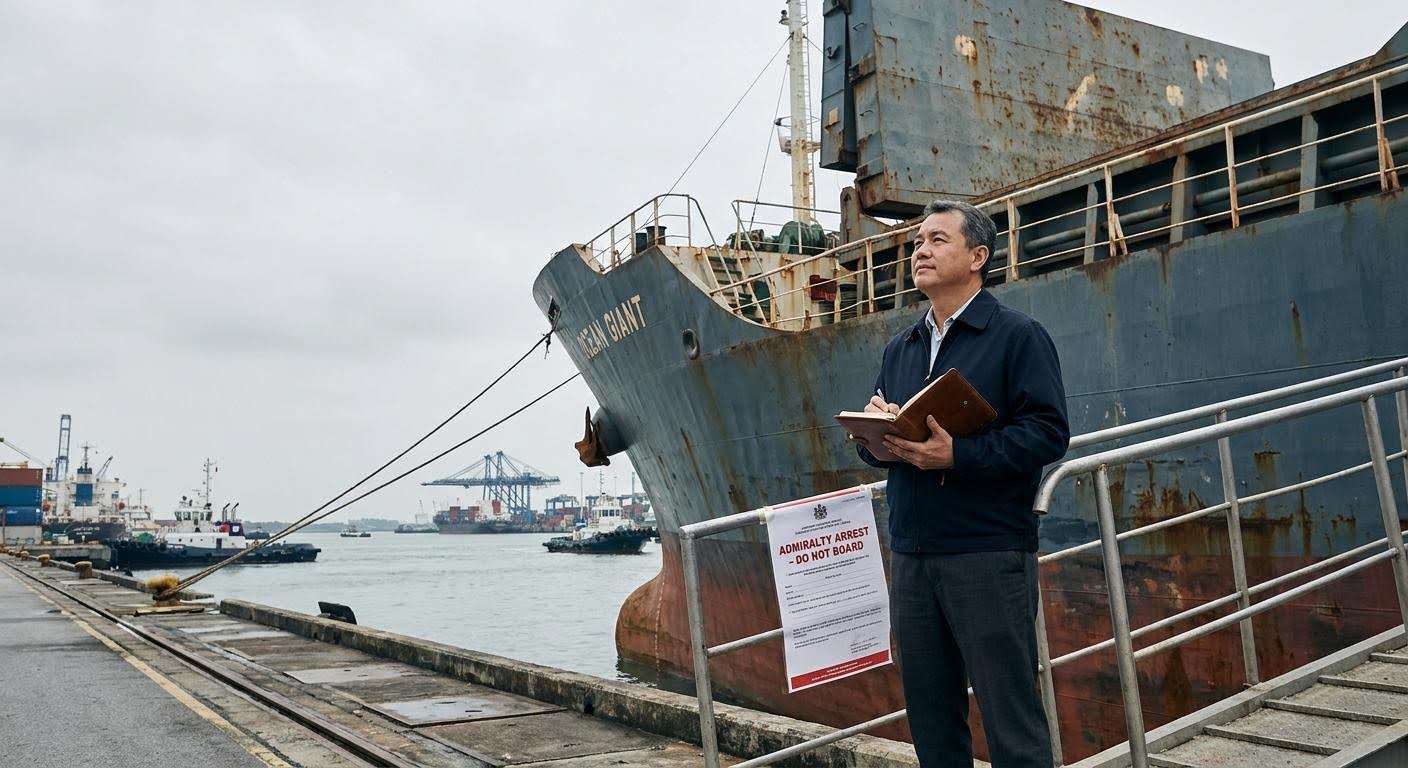
When a ship owner defaults on a marine mortgage, the bank’s recovery team faces a valuation problem that differs fundamentally from a routine financing exercise. The vessel may be under admiralty arrest, accumulating port dues by the day, with a classification certificate approaching expiry and a buyer pool limited to whoever can post funds at short notice. Bank recovery officers, admiralty solicitors, and insolvency practitioners operating in Malaysian waters need a valuation that reflects this reality, not the published market price a broker might quote for an arm’s length sale. For the foundational framework underpinning all vessel valuation in Malaysia, read vessel valuation in Malaysia before proceeding.
Admiralty Arrest and Judicial Sale in Malaysia
Malaysian admiralty jurisdiction is exercised by the Admiralty Division of the High Court of Malaya. The procedural framework for ship arrest and judicial sale is set out in Order 70 of the Rules of Court 2012.
A secured creditor holding a registered ship mortgage pursues an action in rem. The plaintiff files an admiralty writ naming the vessel, and the Admiralty Marshal executes a warrant of arrest once the in-rem claim is properly constituted. The vessel may not leave port without the court’s leave and is typically detained at Port Klang, Penang, or Johor Bahru depending on where it is when the warrant is served.
Once arrested, the court requires an independent appraisal before it will approve a reserve price for the judicial sale auction. The appraiser must hold professional credentials accepted by the court. The appraisal report is filed with the court and disclosed to all parties with a registered interest in the vessel.
The judicial sale is conducted by the Admiralty Marshal through a public auction. Proceeds are distributed according to the maritime lien priority hierarchy: crew wages and salvage rank above the mortgagee, while the mortgagee ranks above unsecured creditors. The Malaysian Maritime Enforcement Agency (MMEA) and the Marine Department of Malaysia may assert claims for outstanding port state fees or statutory dues that the recovery team must model as deductions.
The Merchant Shipping Ordinance 1952 (MSO 1952) governs ship registration and mortgage in Malaysia. A mortgage registered under MSO 1952 is a statutory mortgage, and its priority can be superseded by maritime liens that attach to the vessel by operation of law. Banks holding a ship mortgage must understand this hierarchy before finalising any recovery strategy.
Three Values That Matter in a Default Scenario
The International Valuation Standards Council (IVSC) draws a clear distinction between three bases of value that are directly relevant to vessel default situations.
Market value is the estimated amount for which a vessel should exchange between a willing buyer and willing seller in an arm’s length transaction after proper marketing, where both parties act knowledgeably and without compulsion. This is the number a shipbroker publishes in a circular and the number a financing bank uses to compute the loan-to-value ratio at origination.
Orderly liquidation value assumes disposal within a constrained but not severely compressed timeframe. For most vessel types in the Straits of Malacca region, an orderly liquidation takes 60 to 120 days. The discount from market value reflects vessel type, age, and market liquidity.
Forced liquidation value is the most relevant measure for an admiralty judicial sale. Disposal occurs under compulsion, within a timeline and under conditions the seller does not control. Bidders know the vendor is constrained and price in unknown encumbrances, idle-vessel restoration costs, and condition uncertainty. Per IVSC guidance, forced liquidation value may be significantly lower than market value and is expressed at a specific date because the conditions driving the discount change daily.
The bank’s recovery model must use forced liquidation value as the base case, orderly liquidation value as an upside scenario if a voluntary sale can be negotiated before arrest, and market value only as a reference for measuring impairment.
Valuation Methodology for Forced Sale Conditions
The market approach is the primary methodology. A valuer identifies comparable sales of vessels of similar type, size, age, flag, and class, then adjusts for the specific characteristics of the subject vessel. In a default context, distressed sales and judicial sale transactions must be filtered and treated separately from arm’s length comparables. Distressed sale records anchor the forced liquidation value estimate more reliably than a discount applied to market data.
The buyer pool in a Malaysian judicial sale is narrower than in a global open-market context. International owners based in Greece or Japan are the natural buyer universe for a market value exercise, but they are unlikely to attend a court auction in Kuala Lumpur on 14 days’ notice. The effective pool typically consists of Malaysian-based operators, regional Southeast Asian buyers, and a small number of opportunistic international traders. This pool compression is a structural driver of the auction discount.
The income approach is rarely applicable because there is no ongoing charter stream at the point of arrest. The cost approach may serve as a sanity check but generally overstates recoverable value. For the methodology applied to marine mortgage financing, see vessel valuation for marine mortgage. In a default context, the same market approach is applied with adjustments calibrated to judicial sale constraints.
Key Inputs That Drive the Auction Valuation
Vessel type and trading segment. A tanker with a strong spot market commands better auction interest than a specialised offshore support vessel. Tugboats and barges attract local Malaysian buyers; bulk carriers and container feeders draw a wider regional audience.
Age and condition. Age alone does not drive value. A 20-year-old vessel maintained and drydocked on schedule may outperform a 12-year-old vessel with deferred maintenance. The valuer assesses condition at the point of inspection, which requires boarding the vessel in port under Admiralty Marshal supervision.
Classification status. This is frequently the single most important factor. A vessel in class with a society recognised by the Marine Department of Malaysia (Bureau Veritas, Lloyd’s Register, DNV) can trade immediately after purchase. A lapsed or overdue class means the new owner must fund drydocking and class restoration before trading. Buyers discount aggressively: a lapsed-class vessel may achieve 40 to 60 percent of a classed-equivalent’s market value.
Drydock backlog. Even without a class lapse, an upcoming special or intermediate survey creates a known capital expenditure that buyers deduct from their bid.
P&I cover lapse. A defaulting vessel is unlikely to carry current Protection and Indemnity cover. Without P&I, the vessel cannot trade on most commercial routes. The cost and time to reinstate cover suppresses auction bids.
Fuel and stores onboard. Bunkers and lubricating oil have a recoverable value. The Admiralty Marshal takes inventory and credits consumable proceeds to the recovery pool. The valuer quantifies this separately from the hull.
Port dues and outstanding liabilities. Port dues accumulate from the moment of arrest, rank as maritime claims, and are settled before the mortgagee receives anything. The bank must project port dues to the expected auction date and treat them as a first deduction. Six months at Port Klang or Westport can produce material amounts.
Sheriff and Admiralty Marshal Process
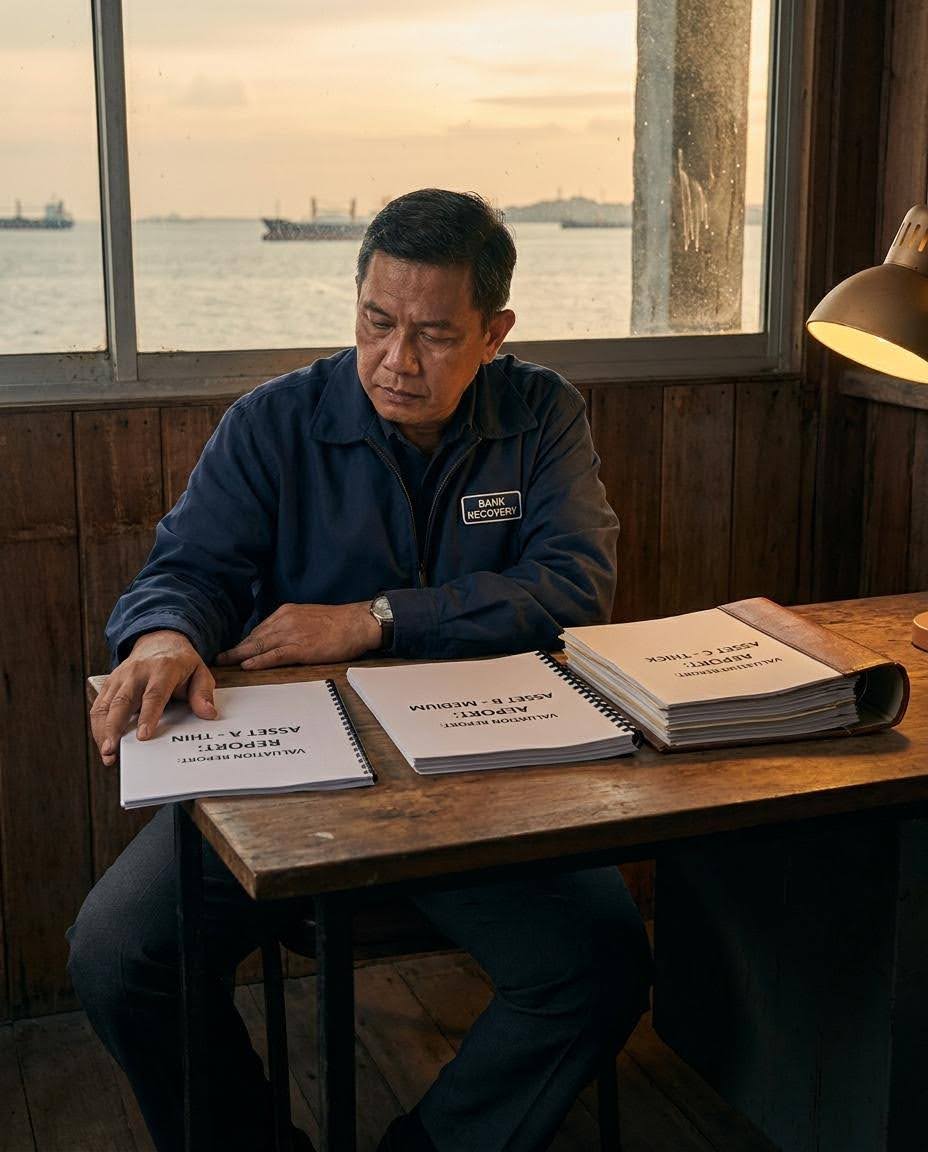
The Admiralty Marshal takes physical possession, maintains the vessel during the arrest period, oversees the auction, and distributes proceeds per court order. The Marshal does not advise on value; that is the court-appointed valuer’s role.
Physical inspection is arranged through the Marshal. The valuer produces written confirmation of appointment and inspects accommodation, engine room, cargo holds or tanks, deck equipment, and bridge. The valuer requests log books, class certificates, insurance records, and maintenance history from the Master or owner’s representative.
The court sets a reserve price based on the valuer’s report. If the auction fails to reach the reserve, the mortgagee may bid at or above the reserve and take title directly, converting the debt to a vessel asset on the bank’s books. Most banks are not equipped to manage a vessel and should plan to avoid this outcome.
Realistic Price Expectations vs Published Market Value
The gap between published market value and achieved judicial sale price in Malaysia is not uniform, but indicative ranges by vessel type and condition provide a useful planning tool for the recovery team.
For a modern, classed, well-maintained vessel with active market demand, the forced liquidation discount from market value in a Malaysian judicial sale is typically 20 to 35 percent. This reflects the constrained buyer pool and the compressed timeline, but not severe condition issues.
For a vessel with an approaching special survey or minor class conditions outstanding, the discount expands to 35 to 50 percent. Buyers absorb the anticipated drydock cost and add a margin for unknown defects.
For a vessel with a lapsed class certificate, significant deferred maintenance, or an operationally compromised engine room, the discount from market value may reach 50 to 70 percent or more. In extreme cases, scrap value becomes the price ceiling.
The published market value from a shipbroker’s circular is therefore almost never the correct planning input for a recovery. Relying on broker indications without a formal forced liquidation valuation consistently leads banks to overprovision expected recovery and underprovision the shortfall. A formal valuation from a registered valuer using the IVSC forced liquidation value basis is the defensible, court-ready number. For context on how marine mortgage security is structured and valued, also see shipping company M&A and fleet acquisition valuation for the fleet-level perspective.
Common Pitfalls in Vessel Default Recovery
Asset deterioration during arrest. A vessel at anchor without a functioning crew deteriorates faster than one in active service. Seawater ingress, corrosion, and idle machinery all erode value between the arrest date and the auction date. Banks should instruct the valuer to re-inspect and update the valuation if proceedings extend beyond six months.
Port dues underestimated. Banks sometimes model port dues as a minor cost. On a large vessel arrested for more than three months, port dues can reach hundreds of thousands of ringgit and represent a meaningful reduction in net proceeds.
Classification lapse during proceedings. If a vessel’s class expires during the arrest period, the bank should seek court leave to appoint a ship manager to maintain class. The cost of maintaining class is almost always lower than the reduction a lapse produces at auction.
Reserve set at market value. A reserve too close to market value will cause the auction to fail, requiring the bank to reapply, reset, and run a second auction. The reserve must be calibrated to forced liquidation value.
Maritime lien priority not confirmed. Crew wage arrears, salvage claims, or statutory maritime charges can absorb a material portion of proceeds before the mortgage is reached. A priority search and lien report must be completed before the recovery strategy is finalised.
Default Valuation Checklist for the Bank Recovery Team
Use this checklist when a vessel mortgage enters default and auction proceedings are being considered.
- [ ] Obtain a formal vessel valuation on a forced liquidation value basis from a registered valuer, separate from any broker’s market value indication.
- [ ] Confirm the vessel’s current classification status with the class society and obtain the survey due dates for upcoming inspections.
- [ ] Assess P&I cover status and estimate reinstatement cost for a new owner.
- [ ] Commission a maritime lien and priority search to identify all claims ranking above the mortgage.
- [ ] Project port dues to the expected auction date and treat as a first deduction in the recovery model.
- [ ] Inspect the vessel physically at the arrest location to assess condition and quantify any deferred maintenance.
- [ ] Confirm registration status under the Merchant Shipping Ordinance 1952 and identify any caveats or other registered interests.
- [ ] Prepare the admiralty solicitor with the valuation report, priority report, and survey status before filing for arrest.
- [ ] If proceedings are expected to extend beyond six months, schedule a valuation update to capture condition deterioration.
- [ ] Review the Rules of Court 2012 Order 70 requirements for the appraisal report format before commissioning the valuation, to ensure it will be accepted by the Admiralty Division without amendment.
MacReal International provides vessel valuation reports prepared to IVSC standards and accepted by the High Court of Malaya Admiralty Division. Our valuers hold recognised professional credentials and carry experience across tankers, bulk carriers, offshore support vessels, tugboats, and barges operating in Malaysian and regional waters.
If you are managing a vessel mortgage default or preparing for admiralty proceedings, contact MacReal for a consultation on forced liquidation valuation and judicial sale appraisal scope.